I’ve made my way all the way to the end of my 20th year of schooling without much in the way of seemingly insurmountable challenges. Sure, the post secondary life is peppered with exams (SAT, ACT, GRE), finals, applications processes, and so on, but while all of these have caused me stress in the past, none even compare to my qualifying exams of my PhD program. This past May, after a year of courses and months of studying, I tackled three days of intense examinations which included a day of two 3-hour Stats Theory exams and nearly 48 hours of a take home applied project. I went in with months of studying, waves of support from friends and family (thanks!) , 6 pages front and back of notes to use, and even a belly full of sushi. I come out… completely and utterly defeated.
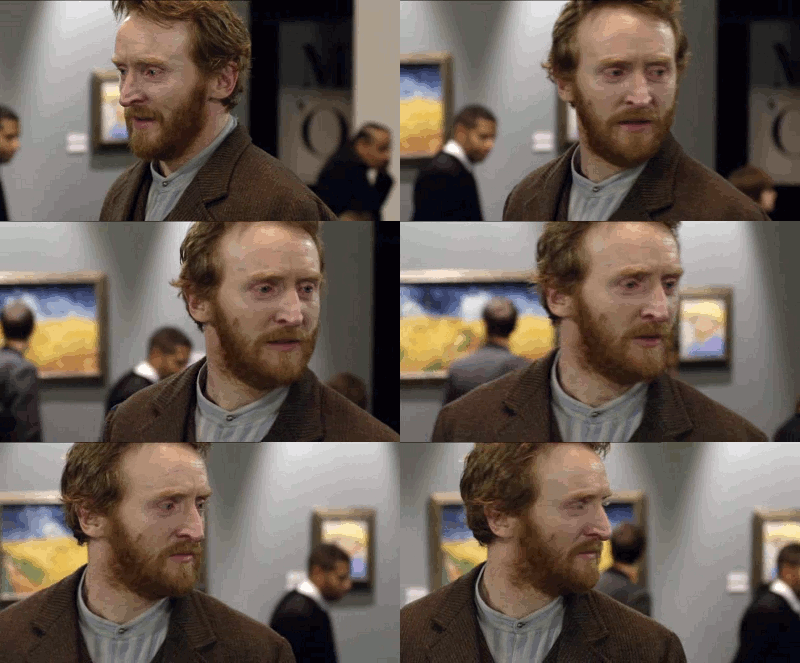
Failed like I failed to keep it together during
this episode of Dr. Who.
Going back a bit, studying leading up to these exams had pretty much become my life on top of coursework for my spring classes. The Fear and Guilt set in early and persisted throughout that time. If I was studying I was afraid of not being able to get enough exam practice and progress made in time. If I wasn’t studying, I felt guilty for spending any of the available time I had on anything else. Maintaining your mental health is important during this time, but it becomes increasingly difficult when anytime you make an effort to carve out time for yourself or your relationships that Guilt is always looming. When that first day finally arrived and we had our two theory exams, I tried to pump myself up and really believe in my abilities. I’d always pulled it together before! My brain was just. not. having it. Some of the questions threw me through a loop, some were from topics from other classes that I had not reviewed, some were fairly straightforward but my scumbag brain decided to wait to remember everything relevant until right as I was turning in my exams.
This week STS will be sharing stories of coming to careers in STEM fields. We hope we can offer three different perspectives on finding your career path, navigating higher education, and deciding how and when your journey needs to change. We’d love to hear any and all of your stories about finding your calling or your struggles/victories if you’re still trying to figure it out right now. Please share! It’s important for all of us (especially those in high school and undergrad) to know that there is no single, best way to approach this crazy adventure. For Part 1, which is Rachel's story, click here. For Part 2, which is Chelsea’s story, click here.
Can I do it on my own?
I have some impressive posts to follow! I am very lucky to have two wildly inspirational best friends that are both doing such amazing things with their lives. I suppose it’s time for my story. Unlike Rachel and Chelsea, after graduating from WKU in 2009 I took an academic year off to reconsider my options for moving forward. I’d had lots of wonderful experiences during my undergraduate years thanks to my mentor, Dr. Albert Meier. At that point I had done research, internships, studying abroad, an honors thesis, but even with all of this involvement, I still was terribly intimidated by the prospect of graduate school. Albert often reassured me that I could go straight into a PhD program, but to me that seemed like rushing the process. During the time I was working on applications to different programs I was living at home and working at a Red Robin to save money. A lot of my friends had already been accepted and moved onto graduate programs while I still had a giant pile of uncertainty in my future. This was a pretty bleak time for me.
Ok, guys. I’ve been studying as a baby statistician (scienctician? statscientist? ecologitician?) for a little while now and I’m here to share some of their secrets. Before I started here at Penn State I had a couple ideas about what other grad students in my department would be like. First, everyone would be computer masters of any and all statistical programs: R, SAS, others that I hadn’t even heard of yet. Second, they’d all be completely on top of everything in all of our classes because they all would’ve completed undergraduate and master’s programs also in statistics. And thirdly, it’d be really hard to relate to other students because of my background in biology and my love for the outdoors (because clearly they’d all prefer sitting inside in front of their computers, right?). Thankfully, I was way off base and not only am I not left in the educational dust, but my cohort is full of awesome students with a wide variety of strengths and abilities. And I must collect them all. Yea, my new goal is to be like some sort of awesome Anna-Paquin-as-Rogue statistician and glean all of the amazing abilities and knowledge while I can. Except I think I’ll stick to taking the time to learn and practice things...instead of the whole touchy hurty thing she does. One of my absolute favorite new acquires is the ability to write and code in LaTeX.
I’m over a month into my PhD program and I’m still oscillating between wild, ecstatic optimism and stone cold, stop you in your tracks fear of the route ahead. Completing a Master’s degree was two and a half years of hard work and setbacks culminating in one of the proudest, happiest moments of my life - successful defending of my thesis. I’m back on track for five more years of the grad student life, but these will be harder, faster, stronger times ahead than before. Good thing I’ve got my Daft Punk pandora station ready to go. My Masters program didn’t entail any qualifying or comprehensive exams so they seem like lofty, impassable goals now. A sentiment shared by my cohort members, but we’ve found that the more information we have the more confidence we gain. We here at STS would like to share what we know about our own roads to knowledge with you the readers so that you guys can find the confidence to face this journey too.
Science documentaries. I’ve got a sneaking suspicion that you love them. You’ve watched both iterations of Cosmos; you’ve joined Stephan Hawkings on an exploration of the universe; you’ve learned about the rovers, landers, orbiters, and space stations exploring our solar system; you’ve experience Sr. David full-on gushing over a hedgehog. If I were to write a blog post trying to convince you to check out some of Sweet Tea Science’s favorite science documentaries, you would scoff because you are so on top of that. And that’s awesome! Seriously, let’s take a moment to appreciate our collective thirst for knowledge!
However, let’s not get so ahead of ourselves that we forget to share this excitement, enthusiasm, and thirst with others!
Once you've gone through the process of finding potential grad school advisers, the next step is to contact them. It can be quite scary. That fear that you'll craft a seemingly marvelous letter, attach your well-written CV, send it off, and then…hear back nothing. Or worse, you'll hear back, but they aren't interested in your obvious brilliance. Try not to get in your own head too much. Think of it more as the start of an epic journey towards the next step in your blossoming academic career. The professors that show the most interest in you are going to be the ones that are the best fit for your unique interests and skills. Writing about yourself is hard, but now is the time to brag on yourself a bit. Say it with me, “I am a badass science baller and all the profs want me.” Keep in mind that this letter does not need to be perfect. I just looked back at the cover letter I sent to my MS advisor (keep anything you write about yourself!) and it’s nearly 2 full pages long with way too much information. Thankfully, she wasn't bored, and I had a wonderful, productive Master’s experience.
Collaboration is a vital part of the scientific process. Do you think I’m going to save the world on my own? Nope. I’m going to need at least a little bit of help. The more great minds working on a project, the faster advancements may be made. And we need advancements (I’m look at you, self-driving car peoples)! Any sort of collaboration is difficult across distances. Technology has made the process easier and email is currently the main tool for communication for researchers. While I’m really proud of the older generations of scientists for getting on track with email, I’m afraid I’m going to have to ask them, and everyone, to utilize Google Drive for their collaboration needs.
Being able to access my Google Drive from anywhere keeps me productive!
This is a question for either of you to answer. Over the course of my last year in school I’ve had the most difficult time finding out how to go about seeking potential (M.S.) advisors for graduate school. Like, I’ve tried looking at schools I would like to go to, and looking at researchers there, but I have had little success in making conclusions when my interests are wide-spread. So, how the hell do I narrow down my interests, and what is a (possibly) better way of finding and approaching potential advisors? I am (mentally) paralyzed.
Thanks, freshlypluckedscientist, for the awesome post request! First off, it’s going to be ok! You are not the only one who has felt like this! I’m also fairly certain that we are not the only two who have felt like this! Rachel and I have both gone through this process twice (M.S. and PhD) and we understand how difficult and frustrating the entire process can be. Both times I tried to get a head start on the process and both times I felt like I was always behind schedule and running out of time! Before I even get started on any suggestions or tips, I’d like to reassure you that it’s completely ok to take a year off to figure things out and generally just chill. I took a year off after undergrad and nearly 2 years off after finishing my M.S. degree. I’m now going to be a few years older than the rest of my cohort, but I am going back fresh and excited and motivated! Like so many big life decisions, you just have to doyou.
Yet another example of how I am constantly amazed by people's ability to distill down difficult topics and concepts and present them in an understandable and entertaining manner. Jorge Cham of Piled Higher and Deeper intersperses comics inspired by life as a grad stud with interviews at various universities and research institutions. This week he traveled to CERN to interview Particle Physicist Daniel Whiteson about the Higgs Boson and how the LHC is attempting to find it.
The combination of visual and audio information presented in such a unique and entertaining way gets me excited to learn about a new topic. I recommend watching the video in full screen to get the entire experience.
* * *
Don't forget to vote in this weeks poll. What sort of posts do you want to see on this blog? More like this one? Your opinion is important to me!
This past week has provided a plethora of Cool Stuff to share! I've enjoyed shifting through stories and videos to select my favorites. Thanks to everyone who shared a link to something extra Cool with me this week!
Be sure to keep you eyes on the night sky again this week/weekend. The Lyrid Meteor Shower should peak April 22.
We've seen that the planets have inspired lots of things: research, space travel, videos, etc; here is a movement from an orchestral suite written in the early 1900s that is intended to convey astrological ideas and emotions associated with the planets on the psyche.
Another great study involving the usefulness of kelp. This time to detect radiation!
In the very first CSS, I had a story about a twister on Mars. Now
another has been spotted that puts the previous 800 meter tall dust devil to shame. The new sighting was over 20 KM HIGH!
If you haven't checked out Monday's, Tuesday's, Wednesday's and Thursday'sblog posts, it'd be best to start there! This week we're having a series of posts discussing scale and size. I'm hoping you all still have your imagination hats handy.
The concepts we've learned about during this week's series, space and time, hold a very important role within scientific research, more specifically, within experimental design. We may also refer to these aspects as spatial and temporal factors, respectively.
An important question to ask in research: So What?
Researchers need to be very mindful of these scales when asking their research questions. This questions will lead to treatment and experimental structure.
When scientists study genetics, they use fruit flies and not elephants. Life span is important.
When entomologists study insects, they often have to consider multiple life stages that occupy both aquatic and terrestrial habitats. Some insects live days, while some may live over a decade.
When climate researchers collect data, they do so over centuries. Perspective related to time is important. Repetition is vital to minimizing experimental error.
100+ years is a long time! Certainly longer than any one researcher could record. (Dang, that would be one heck of a PhD project). However, as science is a field of collaboration, communication, and networks, people have found a way to develop approaches to address the limitations our lifespans present. Long Term Ecological Research (LTER) is currently being conducted at 26 different sights in the U.S. that spans multiple ecosystem types, environmental conditions, and varying levels of human domination of the landscape.
But even looking at data that span a hundred, or even a thousand years becomes less impressive when you start talking to a geologist. A great way to visualize the time frame geologists must consider is to imagine the layers of rocks in the walls of the Grand Canyon. Geologist can match each rock type and layer position to a point in our Earth's history. The further down the rock layer, the older it dates.
You may also confer with a planetary scientist. Or an astronomer. Even a cosmologist. They deal with temporal time scales that stretch back millions or billions of years. Even to that very first moment, the Big Bang.
This week has been a great experience for me. I'll try and do series like these every so often. Next week, we'll return to more sporadic topics for posts. Feedback on these posts is greatly appreciated. Just a head's up, the next application announcements may occur this week. 'Mid-April' is a little vague, but I'm feeling very optimistic. Keep reading, sharing, and commenting if you'd like to read along while I'm on (fake) Mars!
Questions of the Day:
If you are a scientist conducting research, what are some of the spatial and temporal scales that you've had to consider?
If not, can you think of the spatial and temporal scale necessary if someone wanted to study you?
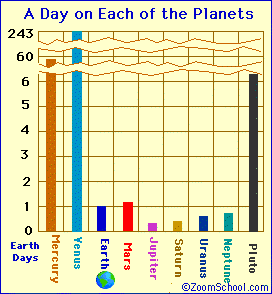
If you haven't checked out Monday's, Tuesday's, and Wednesday'sblog posts, it'd be best to start there! This week we're having a series of posts discussing scale and size. I'm hoping you all still have your imagination hats handy. Size, both great and small, and the ability to perceive it through a series of magnificent inventions are already wondrous enough to contemplate. However, by adding one more aspect to this thought process, we can really understand the importance of scale. Time. We generally think of time in seconds, minutes, hours, and days. If longer stretches are required we have years, decades, and millennia. For those of us on Earth, time is linked to the path of our plant around the sun. A day is the length of time for one rotation of the Earth. 24 hours. A year is one Earth orbit around the sun. 8765.81277 hours. But each planetary body has it's own duration for days and year. On Mars, each day lasts on average 24 hours 37 minutes and 22.663 seconds. Researchers and technicians working with robotic rovers and landers on the red planet must adjust their lives to Mars time. Imagine a whole team waking up about 40 minutes later each day so they can maximize research conducted during the daylight hours on a distant planet. The human concept of time is inherently quite stunted. We have about 80 year to observe, learn, and live. We use time to schedule our lives, educations, and aspirations. We have time allotted for school, work, and play. Holidays are assigned a certain date on our calendar. Sometimes it can feel like a very local concept. But time spreads out over the universe, just like space. All of human history is but a blip in time. If we take the 14 billion years that have occurred since the Big Bang and realign it into a single year, then all of recorded human history has happened in the last 13 seconds. With our universe, time and distances are very closely aligned. Remember that our universe started as a single point from which everything erupted. Time and space included. And with time, the universe expands, thus more space. The building blocks of everything that exists now were created in the seconds following the Big Bang. Everything that composes our body, planet, solar system, galaxy, etc. At first, the universe was mainly comprised of basic elements. Hydrogen, the simplest of all elements was most abundant. One proton, one neutron. As time continued protons began to stick together an eventually Helium. Two protons and neutrons. Allow enough time and more and more elements arise, increasing in complexity. So we've connected time to it's importance in our own lives, and to the lifespan, size, and complexity of the entire universe. We may also use time as a form of distance!
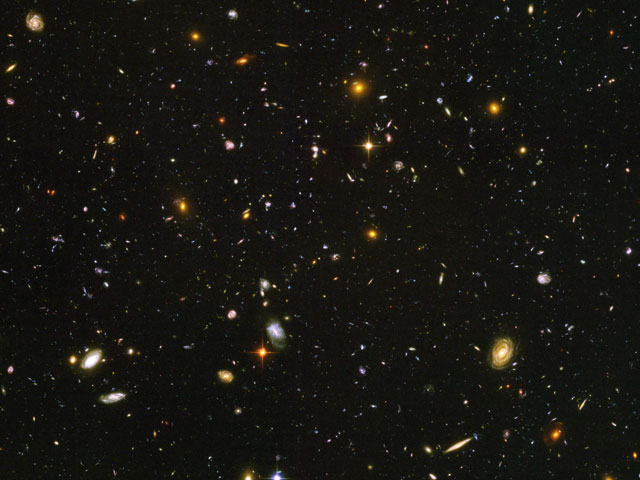
The speed of light in a vacuum is a universal constant valued at 299,792,458 meters per second. You can see this in action by just going out at night and taking in the night sky. Light from stars and reflected from planets is barreling across space to your eyes. The light has traveled hundreds or thousands of light-years to reach you, granting you a glimpse into the past. My artist friend, Danielle, calls it our Museum of Light that serves as a window to our past. Keep in mind that your eyes are the first things these photons have bumped into since they left the surface of a star. Also, that the star you make a wish upon tonight might not exist at this point in time! Remember the Hubble's Deep Field Image from yesterday's post? Those galaxies are some of the oldest we've observed, but we can still collect the light that has been traveling towards us to create an inspiring photo. The following video brings together several concepts from this week's series on scale. As the intro states, this film shoes the known universe as mapped through astronomical observation. Every celestial body is represented to scale and in its correct location. Keep an eye on the lower portion of the video that keeps track of light years traveled.
We're nearing the end of this week's series of posts. I hope to bring everything together tomorrow in the final post. I'd appreciate some feed back on the pace and quality of recent posts. Questions of The Day: Have you enjoyed and learned from these posts? Do you like the idea of a series of posts spanning a week? Do you have a topic in mind that you'd like to know more about?
If you haven't checked out Monday's and Tuesday'sblog post, it'd be best to start there! This week we're having a series of posts discussing scale and size. I'm hoping you all still have your imagination hats handy.
We've discussed and pondered the very tiny, and the unimaginably ginormous this week. I know it's asking a lot to try and comprehend the size of every single component of the universe, in addition to the vastness of the universe itself. No one can be expected to explore everything in existence. Luckily, scientists do not try and approach the issues with such a wide vision. Divide and conquer! Teamwork!
But how? How do you study what you can't see with the naked eye or what you can't reach with current technology?
Inventions! (Do you remember the deep voiced commentator from Bill Nye the Science Guy? Imagine him saying "IN-VEN-TIONS!")
Before any form of microscopy could arise, humans first had to gain a basic understanding of magnification. Surely at some point in history (around the first century AD) some curious fellow noticed that when you look through transparent crystal that is thickest in the middle, what over object you peer at becomes seemingly larger.
And thus, Magnifying Lenses were invented. Named 'lenses' for their similar shape to lentils.
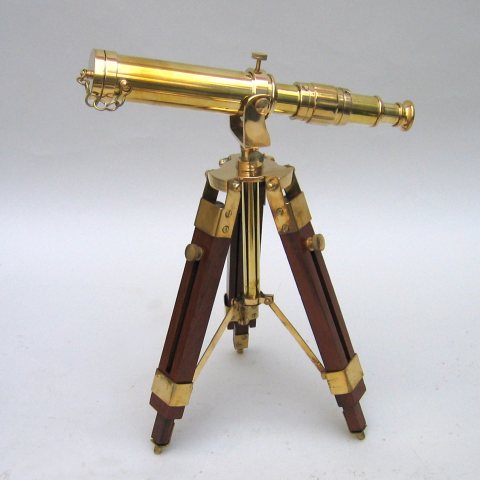
Telescope
Not a lot happened to advance this technology for a few centuries. Imagine living in a time when people had no conception of what we have learned in just two days. They were really missing out!
Eventually people must have grown curiouser and curiouser, because in the late 1500's Dutch father and son, Zaccharias and Hans Janssen, experimented with lenses in a tube, which would eventually lead to more advanced instruments. The telescope was emerging. Some 20 years later, Galileo took a short break from figuring the laws of pendulums and chucking objects off the Tower of Pisa to grab a snack and work out the principles of lenses and a focusing device. No big deal. He turned his attention to the sky and viewed the moon (it was rough!), Jupiter (it had moons?!), and Saturn.
Compound Microscope
However, the true father of microscopy is Anton van Leewenhoek of Holland, and not just because his name is very entertaining to say in the wee hours of the morning after pulling an all-nighter.
Dissecting Microscope
Leewenhoek. No, he actually taught himself how to grind and polish the most advanced curvature in lenses for his time and quite some time after. Since he was the first and only person to reach these magnification levels at this point, he was also the first person to witness some of the tiny marvels of life. His microscopes were the first to see and aid in describing: bacteria, yeast plants, life in a drop of water, and the circulation of blood corpuscles.
His advancements were so impressive that no one could rival his lenses for a few hundred years!
Both compound and dissecting microscopes require illumination by some sort of light source (i.e. light microscopes). However, even in an absolutely perfect situation, they cannot be used to distinguish objects smaller than 0.275 micrometers (or half the wavelength of light). As we've recently learned, there is a whole mess of things to look at beyond this limit. Can't learn much looking at a blur.
SEM - Scanning Electron Microscope
TEM - Transmission Electron Microscope
Hark! The arrival of the electron microscopes in the 1930's provided us with a means to magnify objects up to 1 million times! Provided they wouldn't mind resting in a high vacuum (most living specimen mind). In these microscopes, electrons are sped up so that when beams are focused onto a sample, they are either absorbed or scattered and form an image on an electron-sensitive photographic plate.
In addition to advancing science with their improved optics, these powerful microscopes have lead to amazing works of micro-art.
Butterfly egg perched on a plant tendril to avoid ant predation. Martin Oeggerli.
In the last hundred years, we have made some incredible advancements in technology.
An Array of Radio Telescopes
Radio Telescopes - Differing from optical telescopes, these directional radio antenna operate in the radio frequency. Despite what Jodie Foster would have you think, these do not return data in the form of sound, but rather pictures.
Do not go to New Mexico's Very Large Array and ask to listen for communications.
Trust me on that one.
Multi-Telescope Observatories - Twin telescopes allow increased stability in optics due to two smaller mirrors in place of one large, fragile one.
Hawaii's Big Island hosts two of the world's most important astronomical viewing sites.
Hubble Space Telescope
Hubble Space Telescope - Carried into orbit in 1990, this monster of a telescope is still in operation today, thanks to numerous missions to update and maintain the many instruments and components. Like the electron microscopes, this masterpiece has also managed to provide images that are simply works of art.
NASA pointed Hubble at a particularly dark spot in our night's sky. The following image is the result and contains more than 10,000 galaxies.
Hubble Deep Field Image - the most detailed visible light image of some of the oldest (most distant) galaxies.
Mars HiRise - The High Resolution Imaging Science Experiment is a powerful, and highly useful, camera on board the Mars Reconnaissance Orbiter. Images from HiRISE have aided in locating areas of interest so that they may be later explored by the everlasting bunny, err Opportunity rover. Perhaps this camera, or its successor, will be able to watch over an eventual manned mission on Mars.
Artists Rendition of the Hi-RISE aboard the Reconnaissance Orbiter.
Questions of the Day: Which of these instruments would you like to look through? What would you look at? What kind of advancements do you think lay ahead of us in these fields?
Don't forget to participate in Hubble's Hidden Treasures! You have access to ALL OF THE IMAGES FROM THE HUBBLE TELESCOPE! Two slide shows of the contest Flickr accounts are on the right side of my blog. Go, be inspired!
How small is it? How would you measure it? With what units?
This video, narrated by Stephen Fry, has inspired this weeks look at size and scale. Check it out and then come back for more!
Woah! A nanometer is pretty tiny! If you recall, my research looks at a specific species of micro-algae, Nannocloropsis salina. These guys are only one cell, and can only be seen under a microscope. How many nanometers across are they?
You'll have to take my word for it, but the diatom on the left is about 34 um, while the four N. salina cells are each about 4 um. I can place rulers on the cells individually within the program, but they don't save in the image files. Odd!
So these itsy-bitsy, unseen with the naked eye cells are thousands of nanometers wide. The diatom is about 34,000 nanometers long! In fact, both are so big that we measure them in micrometers (µm).
A look at different size prefixes.
Let's think about this. N. salina is just one cell, and it's 4,000 nm in diameter. What makes up a cell? We can break down even this basic building block into molecules and atoms. How big might they be? What can you find inside of an atom? How big are electrons, neutrons, and protons? Can you go even smaller?
Check out this fantastic website for help answering these questions with an iterative, visual module of the universe.
Surely there can't be many things that are even smaller. Right?
Let's-a-see.
Why do we even need to study anything so unbelievably small?
How big of an impact could they have on us, the giant humans?
We could ask Mr. Owl, over here, but I had better luck searching the web.
And an extra special application that could help with the trip to Mars: The NASA Biocapsule - made of carbon nanotubes - will be able diagnose and treat astronauts in space!
Tune in tomorrow for the continuing saga of Scale Matters!
Question of The Day:
Can you think of any other applications or uses for the extra small objects we learned about?
Reference: Kaltenbrunner, M., White, M.S., Głowacki, E.D., Sekitani, T., Someya, T., Sariciftci, N.S. & Bauer, S. (2012). Ultrathin and lightweight organic solar cells with high flexibility, Nature Communications, 3 770. DOI: 10.1038/ncomms1772
Another beautiful New Mexican Sunday has come and is spoiling me with its warmth and sunshine. These are the types of days that I need to appreciate and remember if I end up participating in the Mars Analog Food Study. I'll just have memories of the sun's warmth and the fresh air's breeze. So enjoy the post and the content I've compiled, but then get off of the internet and go outside! And not just because there might be candy hidden.
Before you check out the videos and links, perhaps you can take a minutes to sign a petition to raise the allotment of tax money to increase NASA's funding?
This guy is not quite as cuddly as the Easter Bunny
A very cool NPR story that I heard on the radio about using music to teach math and fractions!. Creative education that works is so wonderful!
A really creative fix that may allow us to utilize brown seaweed for biofuel! I wouldn't mind going to the coast and helping with that research!
I'm afraid some of the sound clip links may not be functioning, but an interesting article nevertheless about how things sound on different planets! The thunder clips are my favorite!
I came across this video series (The Feynman Series) which serves as a compliment to the Sagan Series. Richard Feynman is another notable scientific communicator. This Nobel Prize co-winner was invaluable to the field of physics and made contributions both within his research and passion for teaching and popularizing the subject. What I really love about these series of videos is that they serve as such unique tools for inspiring interest in the STEM (science, technology, engineering, and mathematics). I want to soak up as many of these as possible so I can understand what I love about them most and try and use that to inspire my own attempts. I've found both more visual and awe-inspiring videos, such as the one above, and more silly attempts:
Another cool TED talk (can you tell I'm border-line obsessed with these?) by the author of Eat, Pray, Love. She talks about the notion of having your 'greatest achievement' accomplished and behind you, as well as the concept of 'being' a genius vs. 'having' genius.
Announcements are set for this week, but still no word from those in charge. I'm assuming that since today is Good Friday, and campuses are closed, then it's very unlikely that they'd be contacting people. Perhaps the weekend? Monday? Another whole week??! All I know is that every time my devices make an email/tweet/ringer/random bleep or blip I tense up in excitement and anticipation.
Fellow applicant, Timothy Judd, has not been especially helpful.
Since I had hoped to use today's blog to share the news of my excitement/disappointment and that will have to wait for another day....here are some little tidbits to keep you going.
The first contains another interview by Kim Binsted, skip to 17:29 for her part.
And then this is just a completely stellar TED-Ed talk by a fish!
I was going to wait a bit until I talked more about this topic, but I'm excited to get it out of my brain onto a post! Earlier this week, I talked about how the Khan Academy has the potential to revolutionize education by allowing students to view video lectures at home and focus on mastering the concepts with help from teachers in the classroom. I've already watch a handful of videos myself and have found them very helpful and educational.
I've been watching videos though the Academy iPad app and have loved how convenient it is. I was able to download videos so that I could watch them during my bus ride (with no internet) back to New Mexico. I felt like could have been in a 'The Future is NOW' ad. I can't help but smile and shake my head in amazement and the products we have available to us.
What's even more amazing is the dedication that Apple and other companies have to the educationsystem. My friend Cornelius received a refurbished iPad as part of a larger donation to Teach for America. He currently uses it as a teaching tool at .... Hopefully we can convince him to write a guest post in the future!
What I'd really like to share with you today is Apple's iBook2 announcement from January 2012. I was nerdy enough to watch the keynote speech the day this initiative was announce and was completely blown away and inspired by what they've created. I have long complained about the antiquity of textbooks, and it seems like the creative, talented people of the world are trying to insight a paradigm shift.
No heavy backpacks. No expensive, out-of-date texts. No boring walls of text.
Why did this take so long?!
Actually, I've already purchased two e-books as required texts for my graduate classes, but this announcement still got me all riled up in a tizzy. After my initial, giddy reaction, I began to spread the good news like it had been passed down from Steve Jobs on high (and he only needed the one tablet). I could see no flaw in the design and expected everyone to be just as excited as I. Most were. But then, gradually different criticisms emerged.
eTextbooks are only available though iBooks 2 on the iPad
iPads are too expensive for most schools
Teachers will be reluctant to adapt new learning platforms
Students already have limited contact with print media. Too many 'gadgets' will actually prevent advancements in certain areas of their education.
Just a new way for students to be distracted in the classroom.
I believe many if these issues will be addressed in the years to come. Even just allowing access to the texts on a Mac computer will placate many naysayers. I've seen predictions of the Retina Display coming to the next generation of MacBooks, so I wouldn't be surprised if that jump is announced alongside the new lineup of computers in the Fall. Certainly, there will need to be a transition period and different platforms will most likely attempt similar version (Kindle), however it is important to remember that initially teachers were not assigning schoolwork that required the internet or even word processors, but those are not integral parts of the classroom.
I'm already growing impatient with the current stale, lifeless textbooks I'm using this semester. After watching that first keynote, I turned my focus back to my studies. Assigned reading in my Statistics textbook.
I felt like my brain was moving in molasses in an attempt to learn the concepts.
I had seen the future and now instead of reading and retaining information, all I could think about was how I could transform the text into an entertaining, interactive experience. I eventually got the chapter read, but it was very clear to me that hey, I could do this! And so, it is now that I announce, nay declare, that I, Meridith, will one day author a completely awesome eTextbook.
Until then, I'll have to manage with the current system.
* * *
Perhaps, if selected, I can convince the Hi-SEAS program to compile the joint experiences of the 6 Astro-Nots and 2 alternates into an iBook. I can easily envision a healthy collection of reports, media, and blog entries that would serve as content.
Can't get to ahead of myself. Still one more week until the first announcements!
Questions of the Day:
Do you think such a radical change can occur in the public school system?
Are you a supporter?
What do you think are the biggest challenges to this idea?
What would you want to see in an end report/book from the 120-day Hi-SEAS food study?
Education has pretty much consumed my life. I have been in school for 19 of my 25 years on this lovely hunk of Earth. I have at the very least another four to go. During the last five years, I've occasionally been on the other side of the equation, teaching and assisting in lab courses. Who knows? Maybe I'll ended up in academia and spend my days warping young minds.
We live in the age of information and technology. It is easier than ever to find a chunk of information via a quick internet search. Educational institutions have been trying to keep up with the ever advancing technologies available today, but I would argue that they should be adapting and leading the pack.
If selected for this research project, I hope to focus on providing fun, interesting, and educational experiences for everyone following along. I will attempt to employ different aspects of technology as often as possible. I've been inspired by different people that have lead they way in this endeavor, and would like to share one of these inspirations today.
Sal Khan and the other amazing folks at Khan Academy are on a mission to change education. Using a vast online database of educational videos, they hope to provide a free world-class education to anyone, anywhere. I've included, below, the TED talk that first introduced me to the Academy. I have since watched several of the provided videos and enjoyed them immensely. The pH/Acid/Base series in the Chemistry section have been profoundly helpful.
Questions of The Day:
Do you think programs such as Khan Academy would work in schools? (Educators, here's looking at you!)
Are there any topics that you could use some extra help in? Try watching a video and let me know how it turns out!